

Have you ever heard your baby say "mummy" or "daddy" for the first time? That first syllable from those tiny lips is like a light that illuminates the whole world. And then what? When they start to point with their little fingers and say their first words? At that moment, you realise that your little baby has grown up and started to experience the excitement of communicating with you.
Stages of Speech Development in Babies
1. First Stage: Crying and Making Sounds (0-3 Months)
When babies are new to the world, their only means of communication is crying. By crying in different tones and intensities, these little friends try to explain their situations such as hunger, need for sleep or discomfort. Loud and intermittent cries usually indicate emergencies such as hunger or pain, while lower-voiced and moaning-like cries may indicate a need for sleep or mild discomfort.
Support Pathways:
- Talk to the baby often and sing him songs.
- Respond quickly when the baby cries, trying to understand its needs.
- Talk in different tones and voices to attract the baby's attention.
2. Clucking and Sound Repetitions (3-6 Months)
During this period, babies start to use their vocal cords more actively with murmurs and sounds such as "goo". These sounds usually express pleasure. Babies listen to the sounds around them and try to imitate these sounds.
Support Pathways:
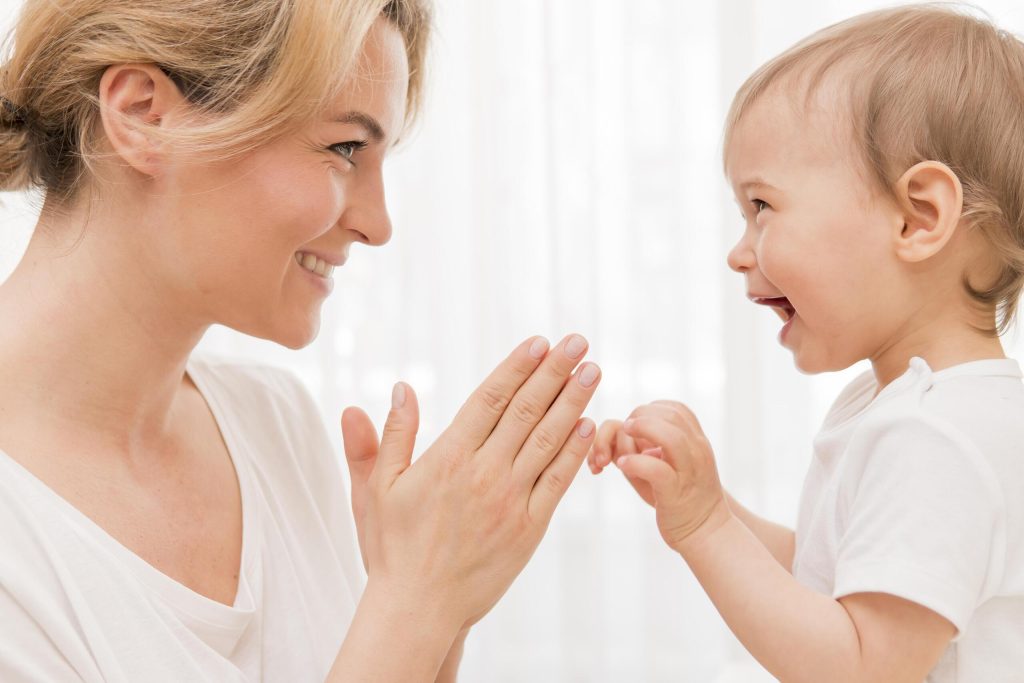
- Talk to the baby face to face and respond to the sounds it makes.
- Speak slowly and clearly when talking to the baby.
- Encourage repetition of sounds by playing games with the baby.
3. Babbling and Repetitions (6-12 Months)
In this period, our little ones take their first steps by repeating sounds such as 'baba' and 'dada'. This process, which we call babbling, is an important turning point in their language journey. As they listen carefully to the conversations around them and try to imitate what they hear, their language skills develop rapidly.
Support Pathways:
- Constantly talk to the baby and teach him the names of objects.
- Show interest in the sounds the baby makes and repeat these sounds.
- Support the baby's language development by reading books and looking at pictures.
4. First Words (12-18 Months)
During this period, babies usually begin to say their first meaningful words. Words such as "mummy" and "daddy" are often among the first words. Babies expand their vocabulary by imitating the words they hear around them.
Support Pathways:
- Talk to the baby often and teach him new words.
- Name objects and actions during daily activities.
- Increase vocabulary by reading books that interest the baby.
5. Two-Word Sentences and More (18-24 Months)
In this period, babies start to form two-word sentences. Simple sentences such as "Give water" and "Mummy come" show that the baby's ability to express is developing. Babies rapidly expand their vocabulary and express their feelings and needs by forming short sentences.
Support Pathways:
- Listen carefully to the baby's sentences and respond to them.
- Encourage the baby to talk by asking open-ended questions.
- Support language development by telling stories and singing songs together.
The Importance of Supporting Speech Development in Babies
Babies' speech development follows a certain process, just like a piece of music. Environmental factors, especially the parents' interaction with their child, are of great importance in this process. Constantly talking to the baby helps him/her to develop language skills and express more complex thoughts. Remember that each child develops at a different pace.
Frequently Asked Questions About Babies' Speech Development
At what age do babies speak at the latest?
Although the age at which babies start speaking varies individually, the first words usually appear between 12-18 months. However, this does not mean that every baby will progress at the same pace. Some babies may start talking earlier, others later.
Is it normal for a 2 year old baby not to speak?
Although a 2-year-old baby can usually say a few words and form simple sentences, every child is different. If your child still does not speak or uses very few words at the age of 2, it is worth consulting a specialist.
How many words does a 1 year old child say?
A 1-year-old child can usually have a vocabulary of between 1-3 words. These words are mostly simple words such as "mummy", "daddy", "ball".
When do smart babies talk?
Intelligent babies are expected to start talking more quickly and form more complex sentences. However, not only intelligence but also the environment in which the child lives affects speech skills. In other words, if even an intelligent baby is not raised in a suitable environment, speech development may slow down.
How to recognise 2-year-old speech delay?
Speech delay at 2 years of age can be manifested by symptoms such as the child using fewer words than his/her peers, not being able to form simple sentences, and having a speech style that is difficult to understand. If you are worried, it is important to consult a paediatrician.
What words does a 2-year-old baby say?
A 2-year-old baby can usually have a vocabulary of between 50-100 words and can use words that are commonly used in everyday life, such as "mummy", "daddy", "ball", "water", "go". They can also start to form simple sentences (e.g. "throw the ball", "mummy come").
What should 2-year-old children do for language development?
- Talk a lot: Talking to your child all the time helps them to expand their vocabulary.
- Read a book: Reading books develops the child's imagination and supports language skills.
- Sing songs: Songs make it easier to memorise words and contribute to language development.
- Play a game: Games develop the child's social skills and encourage the use of language.
What can I do for my 2 year old son to talk?
If you are worried about your son's speech development, you can use the methods mentioned above. You can also get more support by talking to a paediatrician or speech therapist.
What should a 2-year-old child talk about?
A 2-year-old child should be able to express objects, people and actions in his/her environment. It should be able to form simple sentences and answer questions.
What should a 2-year-old child know?
A 2-year-old child should know basic body parts (such as eyes, nose, mouth), some animals (such as dogs, cats) and simple colours (such as red, blue). It should also be able to understand and follow simple instructions.
How old is it normal for a child not to speak?
Most children begin to say a few words by the age of 2. However, if your child is over 2 years old and still does not speak or uses very few words, it is important to consult a specialist.
Which doctor should I see for speech delay at 2 years of age?
For 2-year-old speech delay, you should first consult a paediatrician. The paediatrician will assess the severity of the condition and, if necessary, refer you to a speech therapist.
Note: These frequently asked questions are for general information purposes and are not a substitute for a healthcare professional.
For more information and tips on baby development iskiliga.com You can visit our website and follow our social media accounts!